FOR TEACHERS. FOR THE NEXT GENERATION.
Your class.
Your Splash.
Splashdiving can give a class a reason to describe movement, question rules and practise respectful feedback. This section offers a lesson planner, eight companion worksheets and the original Jump Chart as a visual reference. These resources are editorial working drafts, not a professionally approved practical curriculum. A complete learning pathway is possible without visiting a pool or performing a jump.
Plan a lesson ↘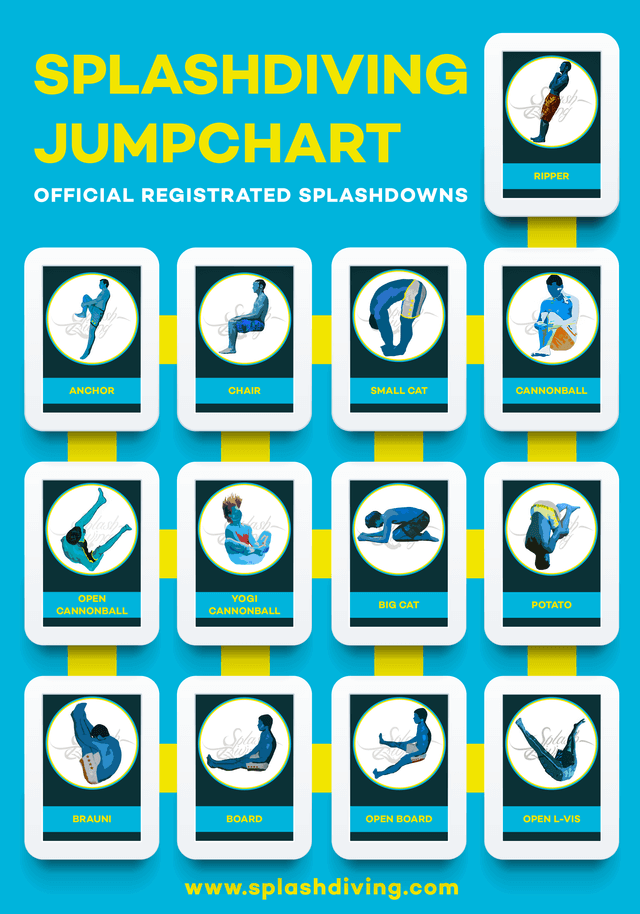
SPLASHDIVING SCHOOL LAB
One class.
Many pathways.
A shared experience.
Turn an exciting sport into a teaching project with clear learning goals, choice and original companion sheets. For mixed-ability groups, not just the most confident pupils. The original Jump Chart connects the lesson with the sport.
Plan my lesson ↘The modules below are a new editorial teaching draft by SPLASHDIVING International, not a professionally approved or officially certified method. A qualified teacher authorises practical work after assessing the group, facility, supervision and applicable rules. Where these conditions are not met, the theory pathway works without a pool.
Supervision: original Unfallkasse NRW guidance ↗Your next lesson
Less preparation.
More shared learning.
Start with what your class should understand and create together. Then choose the theory pathway or consider whether a supervised practical lesson is appropriate at all. That decision belongs to the responsible qualified teacher, applying school and local requirements, not to the planner. Timings refer to net teaching time; allow separately for travel, changing and showers.
One teacher-led practice point; the rest of the group stays in the agreed, supervised waiting/observation area. One person in the take-off area and a landing area cleared by the teacher. No independent water stations. Supervision, rescue capability, sightlines, exit route, emergency procedures and an implemented safeguarding policy must be established beforehand. Stop practical work for pain, discomfort, fear or uncertainty; the teacher decides what follows.
DGUV: teaching and learning swimming ↗SPLASHDIVING SCHOOL LAB · Editorial draft, not practical clearance. Lesson planning: SPLASHDIVING International. Original resources: vlamingo × @digitalerlehrer.
https://www.vlamingo.de/arschbomben-challenge/
https://www.sichere-schule.de/schwimmhalle/lehrkraft/aufsicht
Differentiate without labels
Not everyone does the same.
Everyone belongs.
These pathways are not rankings or diagnoses. The teacher agrees suitable individual tasks; learners may change pathways. Observation, language and design contributions are not consolation prizes, and declining a jump is not a performance deficit.
01 · DISCOVER
Thinking counts.
For learners who are not yet secure swimmers, are anxious or have no practical clearance: describe cards, sequence decisions and identify movement features. No deep water or jumping. Access to the observation area is supervised too.
Visible learning contribution: I explain a rule and justify a decision.
02 · SETTLE IN
Small steps. Real progress.
For learners assessed accordingly by the teacher: familiar water tasks within the permitted area; a feet-first entry only following individual assessment and direct clearance. This pathway is complete without a jump.
Visible learning contribution: I name my boundary and a next learning step.
03 · REFINE
More control. Not more height.
For secure swimmers with individual clearance: repeat a familiar feet-first task selected by the teacher, use feedback and explain a change. No self-directed increases in height or new landing positions.
Visible learning contribution: I describe what I deliberately changed.
04 · CREATE
Your perspective helps the team.
An equal-value pathway with or without water practice: facilitate feedback, design a fair school challenge or create a clear rules card. Pupils never take over supervision or permission to jump.
Visible learning contribution: I give specific feedback without pressure.
Adaptations: short instructions, visual and language supports, enlarged print, additional processing time and school-agreed assistance. Physical, sensory and health-related needs require individual planning with the responsible professionals, not a blanket online suitability label.
Your teaching sequence
Six modules.
No rigid course.
Combine modules into a unit or use them individually. Progression is not automatic from lesson to lesson: the group’s needs decide, not the module number.
01 · Read the sport. 45 min · theory
Compare the original Jump Chart with a vlamingo card. Distinguish a name, an illustration and permission to practise.
Learning product: A source comparison with two similarities, one difference and one open question.
02 · Start together. 45 / 90 min · planning & familiarisation
Assess individual needs through school procedures, agree a stop signal and identify waiting and exit routes. Without confirmed conditions, use theory only.
Learning product: One jointly phrased rule and one personally chosen task.
03 · One task. Your pace. 45 / 90 min · supervised introduction
Use the lesson plan below. One familiar feet-first task, one controlled practice point and specific feedback, rather than thirteen simultaneous jumping tasks.
Learning product: A short before/after comparison or an equal-value observation contribution.
04 · Notice. Explain. Learn. 45 min · feedback
Two learners describe one observable feature. The learner agrees their next step with the teacher. Feedback is not a safety decision.
Learning product: Two respectful feedback statements and a clear learning goal.
05 · Our fair challenge. 45 / 90 min · cooperation
Small groups plan a presentation of sequential individual contributions. No synchronised entries. No points for height, riskier positions or the biggest splash.
Learning product: A team sequence with equal-value participation for learners outside the water.
06 · Make progress visible. 45 min · reflection
Compare learning products and chosen tasks. What became more controlled, clearer or fairer? Discuss transfer to other sports. Photos and videos are not required.
Learning product: A learning portfolio with attribution, self-assessment and a next goal.
Original resources · directly from the creators
Great cards.
From their creators.
The teaching package “Arschbomben-Challenge: 13 Sprungkarten für den Schwimmunterricht” is by Henrik Lühr, Ramy Azrak and Florian Schwarzlose (@digitalerlehrer), with illustrations by Alina Schlegel. Teachers and schools can obtain the complete German resource through vlamingo’s original offering.
Title and creator credits according to the vlamingo product page.
The vlamingo teaching materials on Splashdiving provided on this website were developed jointly by vlamingo and Splashdiving. The graphics and content used for this purpose have been authorised by vlamingo, Henrik Lühr, for the agreed use by Splashdiving.
The copyright entitlements of the respective rights holders remain unaffected. This authorisation applies solely within the scope of the underlying agreement and does not grant third parties a general right to reproduce, adapt, distribute or otherwise reuse the materials. Any further use requires the corresponding authorisation.
The School Lab lesson planner, learning pathways and eight additional worksheets are separate editorial companion resources by SPLASHDIVING International. The complete vlamingo package remains available through its original offering.
This rights authorisation does not constitute certification or replace professional assessment and local approval of a practical teaching activity.
Original additions · SPLASHDIVING International
Eight sheets.
One shared thread.
New theory, cooperation and reflection sheets for the School Lab. No redrawn source cards and no substitute for the vlamingo package. Every task works without jumping or visiting a pool.
01 · IMAGE & SOURCE
Read the sport. Recognise sources.
SPLASHDIVING SCHOOL LAB · 01 · IMAGE & SOURCE
Read the sport. Recognise sources.
Open the original Jump Chart. Choose two names and describe one visible feature of each. Use the illustrations without physically imitating the positions.
Original editorial draft · not practical clearance or certification. No names or health information required.
SPLASHDIVING International · SD-SCHOOL-2026-10-R2
https://splashdiving.com/index.php/schulen-training/
02 · RESPONSIBILITY
Our setting. Our roles.
SPLASHDIVING SCHOOL LAB · 02 · RESPONSIBILITY
Our setting. Our roles.
Identify responsibilities: the qualified teacher decides on practical work and supervision. Learners can describe, ask questions and give feedback. Peers do not give permission to jump.
Original editorial draft · not practical clearance or certification. No names or health information required.
SPLASHDIVING International · SD-SCHOOL-2026-10-R2
https://splashdiving.com/index.php/schulen-training/
03 · SELF-DETERMINATION
My choice matters.
SPLASHDIVING SCHOOL LAB · 03 · SELF-DETERMINATION
My choice matters.
Agree an appropriate contribution with the teacher: describe, explain, create or complete an individually authorised task. Nobody has to demonstrate a jump. Do not write health information on this sheet.
Original editorial draft · not practical clearance or certification. No names or health information required.
SPLASHDIVING International · SD-SCHOOL-2026-10-R2
https://splashdiving.com/index.php/schulen-training/
04 · SHARED RULES
Stop means stop.
SPLASHDIVING SCHOOL LAB · 04 · SHARED RULES
Stop means stop.
Write three clear rules against peer pressure. Discuss the agreed stop procedure with the teacher. This sheet is not an operational emergency plan.
Original editorial draft · not practical clearance or certification. No names or health information required.
SPLASHDIVING International · SD-SCHOOL-2026-10-R2
https://splashdiving.com/index.php/schulen-training/
05 · FEEDBACK
Notice. Ask. Learn.
SPLASHDIVING SCHOOL LAB · 05 · FEEDBACK
Notice. Ask. Learn.
Choose a visual, verbal or design contribution. Describe only what you actually notice. Do not comment on bodies, courage or fear or encourage greater height.
Original editorial draft · not practical clearance or certification. No names or health information required.
SPLASHDIVING International · SD-SCHOOL-2026-10-R2
https://splashdiving.com/index.php/schulen-training/
06 · TEAM STORYBOARD
One team. Different contributions.
SPLASHDIVING SCHOOL LAB · 06 · TEAM STORYBOARD
One team. Different contributions.
Plan a short presentation using explanation, source-sharing and feedback. Contributions happen sequentially. Do not plan synchronised entries or assign supervision or rescue duties to learners.
Original editorial draft · not practical clearance or certification. No names or health information required.
SPLASHDIVING International · SD-SCHOOL-2026-10-R2
https://splashdiving.com/index.php/schulen-training/
07 · REFLECTION
My progress. No leaderboard.
SPLASHDIVING SCHOOL LAB · 07 · REFLECTION
My progress. No leaderboard.
Record a concrete example for each criterion. Describe your progress as “with support”, “increasingly independent” or “independent and reasoned”. This creates neither an automatic grade nor a qualification.
Original editorial draft · not practical clearance or certification. No names or health information required.
SPLASHDIVING International · SD-SCHOOL-2026-10-R2
https://splashdiving.com/index.php/schulen-training/
08 · TRANSFER
What stays. What comes next.
SPLASHDIVING SCHOOL LAB · 08 · TRANSFER
What stays. What comes next.
Summarise your learning product and transfer one insight to another sport or group situation. Focus on understanding and cooperation, not increasing jump height or risk.
Original editorial draft · not practical clearance or certification. No names or health information required.
SPLASHDIVING International · SD-SCHOOL-2026-10-R2
https://splashdiving.com/index.php/schulen-training/
Print locally and use the designated school documentation procedures. There are no pupil accounts, personal-information fields or uploads here.
Feedback, not a dare
Progress is more
than a big splash.
Our own reflection framework for this unit, not vlamingo’s original or an official competition score. Agree the four criteria in advance. Describe each as “with support”, “increasingly independent” or “independent and reasoned”; no automatic grade or public leaderboard.
| Criterion | What makes learning visible |
|---|---|
| Decisions | I recognise limits and use stop/clearance procedures. |
| Learning | I describe my progress or a reasoned observation. |
| Cooperation | I give helpful feedback and accept a no. |
| Reflection | I explain my next step and identify my source. |
All four pathways can demonstrate all four criteria. Height, riskier landings, pain or overcoming fear earn no bonus. Formal grading follows local curricula, agreed accommodations and the responsible teacher’s judgement.
End-of-lesson reflection: Today I learned … / My boundary was … / What helped was … / Next I would like to …
The teacher stays in charge.
The class stays a team.
The planner neither stores nor transmits selections. Pupil names, health details and individual assessments do not belong on this public page. Print locally or save as PDF using your print dialogue. No pupil accounts, mandatory uploads or compulsory filming.
Discuss a supported school project ↗Real resources. Clear attribution.
Own archive · original artwork
Jump Chart
Explore the 13 named positions in the supplied chart. This is a visual reference, not a difficulty rating or permission to jump.
Open the interactive chart ↗External teaching literature · 2009 · German
Peter Neumann
“Splashdiving im Sportunterricht?” presents ideas for a school-sport project in Lehrhilfen für den Sportunterricht, volume 58, issue 8 (2009). Read the original via DSLV (PDF) ↗
Historical professional article, not proof of current local permission or school rules.
External workshop handout · German
Susanne Kleinalstede
“Das Wasser bewegen – Splashdiving im Schulsport” is a teaching handout hosted by Bielefeld University. Read the original handout (PDF) ↗
Undated in the document. External content must be reviewed by the responsible teaching staff; it is not automatically adopted as a current Splashdiving rulebook.
External safety planning · August 2025 · German
DGUV Information 202-048
The DGUV’s “Checklisten zur Sicherheit im Schulsport” includes a swimming section addressing organisational measures and regional school requirements. Read the DGUV original (PDF) ↗
General school-sport guidance, not a specific approval of Splashdiving.
External professional literature is linked at its original publisher. The complete vlamingo teaching package is available from vlamingo, not as a download on this website. Our planning and reflection sheets are separate companion resources. Having materials or a literature reference does not replace professional assessment or local approval of a teaching activity.
First, clarify the setting.
An editorial planning aid for discussions within the school and with the pool operator. It does not replace the applicable rules, professional assessment or approval.
No names, health information or individual assessments are collected. Selections are not stored.
Two worksheets. No water required.
New editorial theory and planning drafts by SPLASHDIVING International. They are not the recovered historical school materials and have not been presented as a professionally approved practical curriculum.
Worksheet · Read the Jump Chart
SPLASHDIVING · Theory worksheet · editorial draft
Look closely. Name it. Ask questions.
Use the original chart as a visual source. No jumping or practical demonstration is part of this worksheet.
Choose three names. Which three named positions can you identify in the chart?
Describe what is visible. Pick one illustration. Describe the posture you see, without giving an instruction to imitate it.
What does an image not tell you? Name information about a sporting situation that cannot be established from a photo or chart alone.
Respect is part of the sport. Write a sentence that supports someone who does not want to take part in a practical activity.
Visual source: https://splashdiving.com/wp-content/uploads/2025/10/splashdiving-jumpchart.png
No exercise prescription, no safe-height or water-depth specification, no approval for practical use.
Planning sheet · Questions before practice
SPLASHDIVING · Teacher planning sheet · editorial draft
Clarify before committing.
For discussions with school leadership, qualified teaching staff and the facility operator. This sheet records questions; it does not authorise an activity.
Which regional requirements and school procedures apply? Who verifies them?
Who is responsible for teaching, supervision and emergency organisation?
Which parts of the facility and which activities has the operator permitted? What remains unresolved?
How will individual needs, voluntary participation and alternatives be addressed?
Which decisions require a qualified assessment? Who documents the outcome?
Further original guidance: DGUV Information 202-048, https://publikationen.dguv.de/widgets/pdf/download/article/1410
No individual pupil or health information should be entered on this public web page.
A school project in mind?
Tell us about your institution and the kind of project you want to discuss. Availability, responsibilities and any practical component need to be clarified individually.
Discuss a school project ↗FOR POOLS · SELF-RUN OR WITH US
Your pool. Your splash.
Starter package: original Jump Chart and four scoring books for €450 net. Self-run fun competition of around five hours; support, shows and Pool Bombs are separately planned and quoted.