Bevor es Splashdiving heißt. Wie aus einem Freibadsommer eine Sportart wird.

The origin · 2003–2010 · Recollections recorded in 2026
Before it is called Splashdiving.
How a summer at the pool becomes a sport. An origin story drawn from Oliver Hillebrecht’s memories and checked against contemporary reporting.
Explore the chapters
- The boy on the ten-metre platform
- Two ways of meeting the water
- Nobody invents summer
- Bayreuth, summer 2003
- A pool becomes a stage
- Television takes an interest
- The people behind the positions
- The Brownie that should have been Knaubi
- Patrick Baumann and the Brett
- Development also means drawing a line
- Ideas become a system
- A name that travels
- The original has many faces
The boy on the ten-metre platform
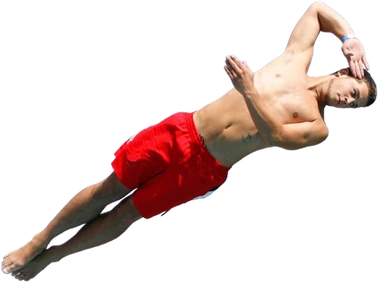
At the outdoor pool, there is this one boy. He climbs to the ten-metre platform, and heads turn below. Some people remember him from last summer. Others are about to find out why everyone is looking up.
He stands at the edge. Beneath him lies the pool; around him, an audience that has not come to be an audience. Friends interrupt their conversation. Someone pulls their legs back from the water. Then he jumps, and for a brief moment he has everyone’s attention.
The water rises. He surfaces, wipes his face and hears the calls from the side. Someone wants to know whether he will do it again. Of course he will.
If you grow up around outdoor pools, you know these scenes. The best jumper earns a reputation without a certificate. Other people give it to him. They know his signature jump, his courage, sometimes his overconfidence. For a few weeks, perhaps for several summers, he is the person everyone measures themselves against.
Long before there is a Jump Chart, there is that upward glance. Long before anyone awards points, there is the desire to jump again.
Two ways of meeting the water
An older trail leads to Hawaiʻi: in accounts of traditional Hawaiian diving, lele kawa describes entering the water with little splash, while lele pahu describes a forceful, splashing entry. Pahu means “drum”, making “entering the water like a drum” an evocative free image for lele pahu, rather than a literal translation asserted here.Sources: Westfälische Nachrichten on the historical distinction · Smithsonian Music
Hawaiian diving traditions are associated with Kahekili II, the ruler of Maui whose life is commonly dated to approximately 1737–1794. This does not establish a direct lineage to modern Splashdiving, or prove that he invents a cannonball competition.Sources: Kahekili II · cliff-diving traditions
The useful distinction is simpler. We can try to leave almost no trace, or make our arrival an event. This is not a complete classification of every way of diving. It is a way of understanding their different effects.
In one case, we admire how quietly a body can disappear. In the other, we wait for the whole pool to answer.
Nobody invents summer
Oliver Hillebrecht does not invent the cannonball. He does not claim to. People jump into water, name their jumps and show each other what they can do long before his idea becomes an event format.
Names change from pool to pool. A term everyone knows in one town means nothing somewhere else. Some positions resemble each other; others emerge from a small adjustment. What connects them is the pleasure of trying something personal and showing it to the others.
Oliver knows this world as an active diver. His question is not how to pass off an old movement as a new invention. He wonders what it could become if people take it seriously.
How do you compare different jumps? What does a jury assess? How do you leave room for individuality without making the competition arbitrary? How do you organise a summer’s day so that something can happen again the following year?
He is thinking about a format. At first, the distinction sounds small. For everything that follows, it matters.
Bayreuth, summer 2003
In 2003, the idea takes competitive shape at Bayreuth’s Kreuzsteinbad as the Pecklaman Cup, also written Pecklamann-Cup in contemporary reporting. The Franconian word “Peckla” means a small parcel, an image of the compact shape of a classic cannonball.Sources: DER SPIEGEL on the 2003 beginning · Pecklaman Cup history · DER SPIEGEL
In dialect, the word sounds rooted in the region and relaxed. For the wider public, however, the name PECKLA sounded more intriguing without the German Ä vowel, Oliver recalls.
Oliver remembers other cannonball contests and earlier attempts to build events around the jump. His beginning needs no invented claim to being the first person ever to organise one. It needs to offer something that can last beyond a single day.
For the diver, the attempt matters. For the organiser, work begins beforehand and continues afterwards. People need to know when they compete, what is expected of them and why a score is awarded.
These perspectives meet at the Kreuzsteinbad. Oliver brings his experience in the water and begins to give it a structure on land.
The first competition makes a sequel possible. A year later comes “Arschbombe. Die Weltmeisterschaft”, the 2004 world championship in Bayreuth that attracts national reporting.Sources: DER SPIEGEL, 16 August 2004
A pool becomes a stage
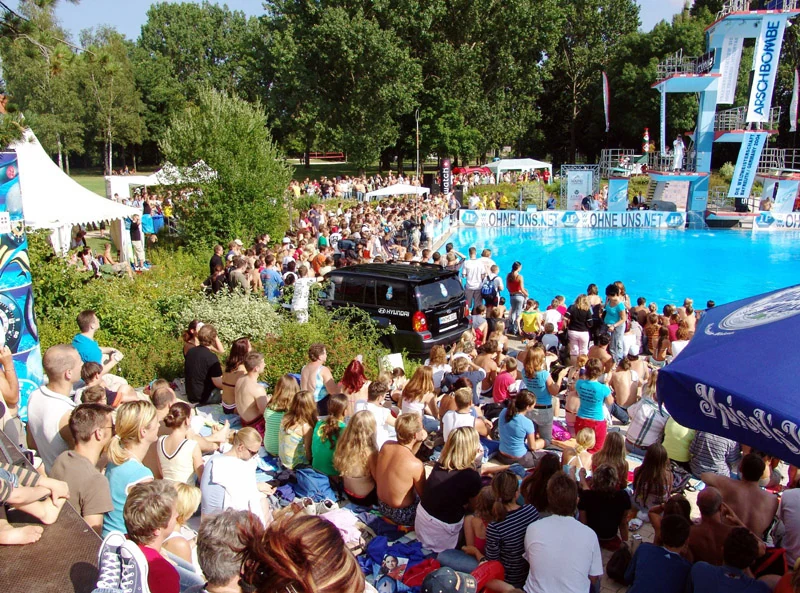
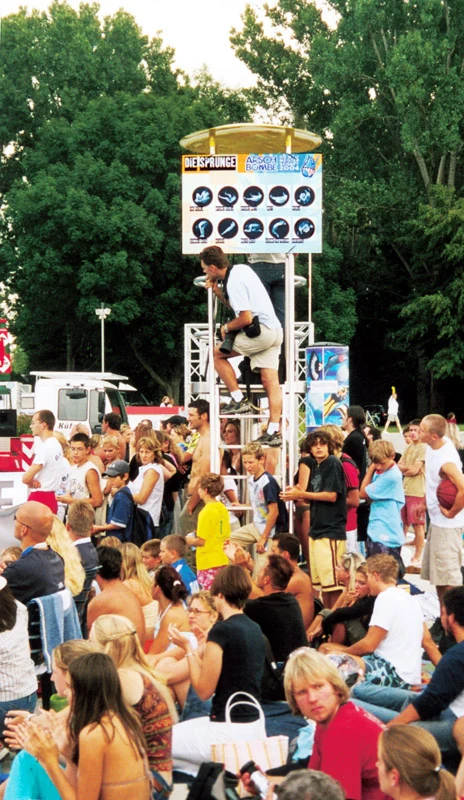
Now it is not only friends watching from the side. Cameras point towards the platform; reporters want to understand what is happening. Contemporary reporting describes compulsory and optional jumps, different degrees of difficulty and a jury: behind the unusual name is an organised competitive system.Sources: DER SPIEGEL
For Oliver, the attention feels overwhelming. In his memory, another camera crew is always arriving, another person has a question, another needs pictures. For the people there, it is an experience that changes their sense of how far the event might travel.
Christian “Elvis” Guth wins the men’s competition and Mona Hoffmann the women’s, names recorded in the reporting of the time. People who love diving become recognisable faces of a format.Sources: DER SPIEGEL
Between interviews, filming and applause, one question remains. Is the world watching an unusual summer story? Or the beginning of something that can stay?
Television takes an interest
German television is exploring new combinations of sport and entertainment: the Wok World Championship starts in 2003, followed by TV total Turmspringen in 2004. Oliver remembers “Physical Entertainment” as part of that mood: physical performance, personality and a competition people enjoy watching together.Sources: HORIZONT’s history of TV-total formats
He recalls meetings in Cologne, Schanzenstraße and presenting his concept. In his account, discussions in the ProSieben production environment include the possibility of a joint cannonball competition. He explains procedures, decisions and the thinking behind his format.
No joint cannonball format results. What Oliver takes from the experience is that the idea interests people beyond the pool. For his own work, a television appearance is not enough. The jumping has to continue after the cameras leave.
The people behind the positions
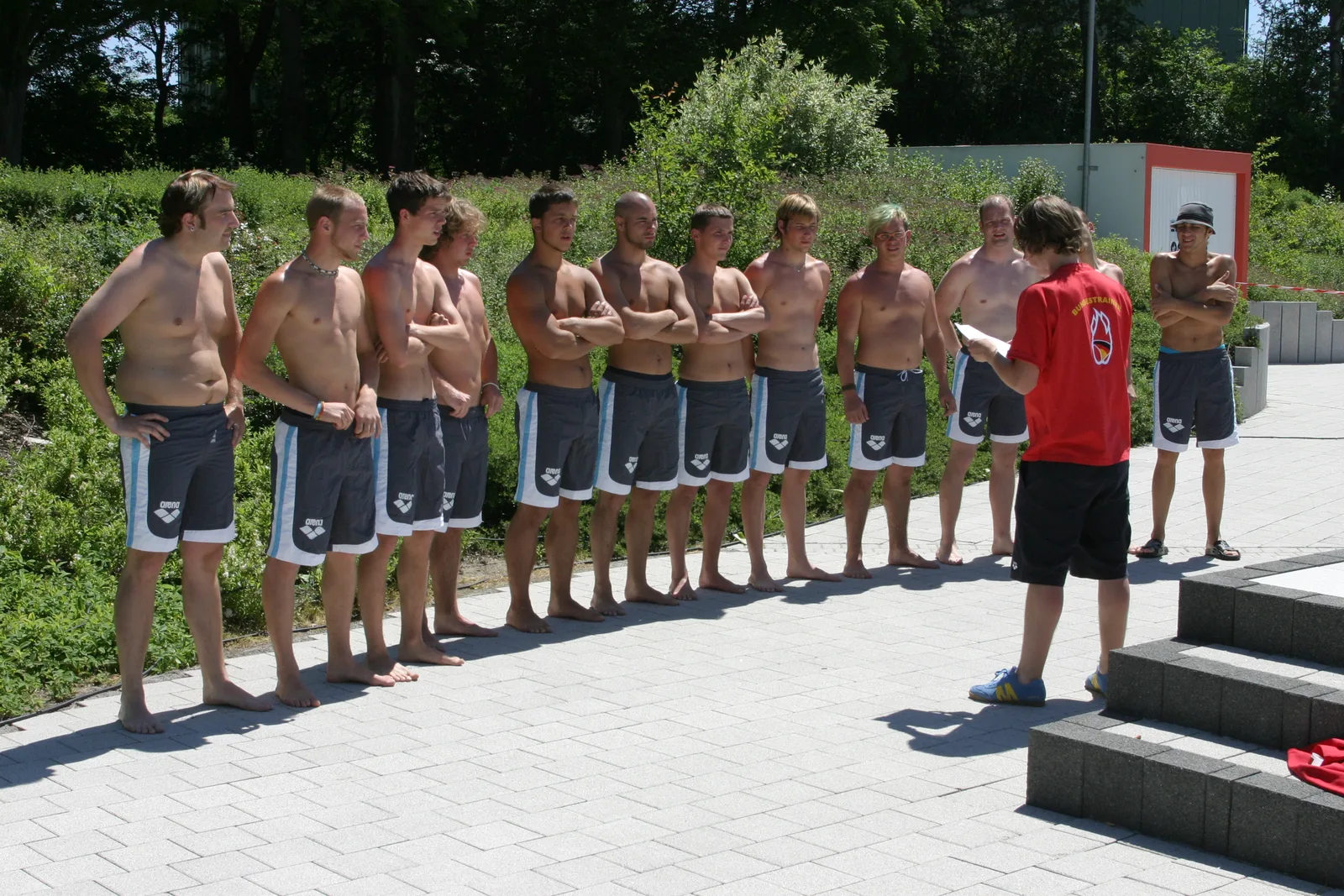
In Oliver’s recollection of the early landing positions, people come first. Patrick Baumann, Christian “Elvis” Guth, Dominik Dehmel and Michael Schmidt belong to the circle experimenting, observing and developing ideas with him. Ron Knaub and Thorsten Braun also belong in this story. And when Oliver talks about those days, the nickname “Mufti” comes back too.
A position does not begin simply because somebody names it at a desk. First there is a body in the water, an idea being tried, other people watching closely. They notice a difference, discuss it and remember it at the next training session.
The early repertoire acquires its character this way. Some names immediately stick. Others come about through circumstances that would be difficult to invent.
The Jump Chart records these forms. What previously lives between individual divers and their pools becomes visible on a board, receives a name and can be recognised within a shared system.
The Brownie that should have been Knaubi
One story begins with Ron Knaub. Oliver credits him with developing the position later known as Brownie or Brauni. Both Ron and Thorsten Braun are associated with this jump in the early team, but the familiar name points to the wrong person.
In Oliver’s recollection, a naming mix-up happens in the office of the Arschbombe headquarters. “Knaubi”, intended to refer to Ron, becomes “Brauni”. The position appears under that name on the first Jump Chart in 2004, as he tells its history.
Ron is asked whether he wants it changed. Oliver remembers that he does not insist. The name stays and gradually becomes detached from the small mistake that produces it.
It matters to retain both parts of the account. The established name remains Brownie or Brauni. Oliver credits the development of the position to Ron Knaub, rather than simply to the surname Braun.
It is a memory with a smile in it. It also restores someone’s place in a history that cannot be read from a printed chart alone.
Patrick Baumann and the Brett
When it comes to the Brett, Oliver is emphatic. He credits Patrick Baumann with developing this position within the early team. Patrick should remain connected to the jump rather than disappearing behind its fame.
In Oliver’s memory, the moment is still close. Patrick deliberately jumps from ten metres. The others are there, watching and waiting for contact with the water.
Then comes the impact. For a moment there is only that sound; immediately afterwards comes the group’s laughter, as Oliver still tells it. Together they experience something that stays with them and later carries a fixed name: the Brett.
Within the story of this team and its Jump Chart, Patrick’s name belongs with the Brett. Oliver wants to preserve that connection so that the position’s developer is remembered alongside it.
Sometimes recognition starts with a trophy. Here it starts with people who remember, years later, exactly whose jump they are watching.
Development also means drawing a line
Not every new idea becomes part of the Jump Chart. Oliver also remembers Brian Dee Müller developing a further position, which he calls “Zoom” in his present account and which is excluded from the official repertoire because of its danger.
This is an important part of building the format. A sport needs people who discover possibilities. It also needs decisions about what does not belong in regulated competition.
These jumps are historical recollections involving experienced athletes, not instructions to imitate them. Training requires qualified supervision and approved facilities; a spectacular archive photograph does not show what is safe for an individual visitor.
Ideas become a system
Oliver Hillebrecht, identified in contemporary reports as Oliver Schill, works on the structure behind the competition. In his account, that includes the Jump Chart, regulations, scoring, event procedures and technical production.Sources: DER SPIEGEL, 2004 · STERN / dpa, 2006
On paper, some of this sounds unremarkable. On the day, it determines whether people can trust one another. Divers need to know what counts. A jury must make understandable decisions. An organiser needs a working schedule that does not depend on one good idea at the microphone.
Oliver remembers building the organisational and marketing work with Anne Schmidt-Gahlen. Meetings, plans, documents, dates and connections between events create something barely visible in the finished film: continuity.
Sports-science engagement is part of the story too. Oliver names Professor Wolfgang Buskies and Ulrich Fehr of the University of Bayreuth as the specialists who, in his recollection, engage with the emerging sport early on. A later report attributes recognition as a sport to Buskies in 2006. This means a sports scientist’s professional assessment here, not a formal resolution by a sporting federation.Sources: Süddeutsche Zeitung, 26 July 2022
This attention changes how the activity can be understood. Behind the loud arrival in the water are movements that can be studied, trained and assessed. The enjoyment does not disappear. It gains a framework in which performance becomes visible.
A name that travels
In 2006, the championship in Dillingen carries the name Splashdiving Worldchampionship, a change contemporary reporting explicitly connects with international understanding. Arschbombe remains part of the origin. Splashdiving can travel beyond it.Sources: STERN / dpa, 14 August 2006
Looking back, Oliver regards the essential groundwork as established by 2010. That does not mean a sport is finished. It means a single competition has become a repeatable system with its own name, imagery and recognisable team.
He produces footage and supplies it for international distribution. Today he describes that distribution as covering more than 200 countries. Organising a competition becomes, alongside everything else, the task of telling a distant audience about it.
The pictures can travel to places where nobody knows the Kreuzsteinbad. You do not need to understand a Franconian word to see a person take off, work in the air and send water high above the poolside.
The original has many faces
The beginning is not an invention of the human desire to move. There is someone by the water who wants to jump, and someone else looking on. What grows in Bayreuth bears the signature of a particular format and the people who build it.
Oliver gives the idea structure and works with Anne to carry it beyond individual events. Divers contribute their abilities, positions and personalities. A name gets mixed up. A Brett hits the water. Someone laughs so hard that the memory remains warm decades later.
The Pecklaman Cup in 2003 and “Arschbombe. Die Weltmeisterschaft” in 2004 lead towards Splashdiving. The story does not belong only to the person organising it. It also belongs to those without whom there would be nothing to organise.
Perhaps that is the strength of this beginning. You can write regulations, dress a diving tower and position a camera. You cannot commission people’s desire to talk about a shared summer years afterwards.
They tell the story because they are part of it. Because they know one another. Beneath the names, journeys and pictures, a familiar feeling remains: someone is about to jump. Look up.